
Bringing the borderless Lakehouse into the agentic era with innovations for Gemini
As enterprises shift their AI usage from experimental chatbots to autonomous agents, teams are hitting a critical bottleneck: accessing and reasoning over data scattered across multiple clouds, SaaS platforms, and on-premises systems.
As enterprises shift their AI usage from experimental chatbots to autonomous agents, teams are hitting a critical bottleneck: accessing and reasoning over data scattered across multiple clouds, SaaS platforms, and on-premises systems.
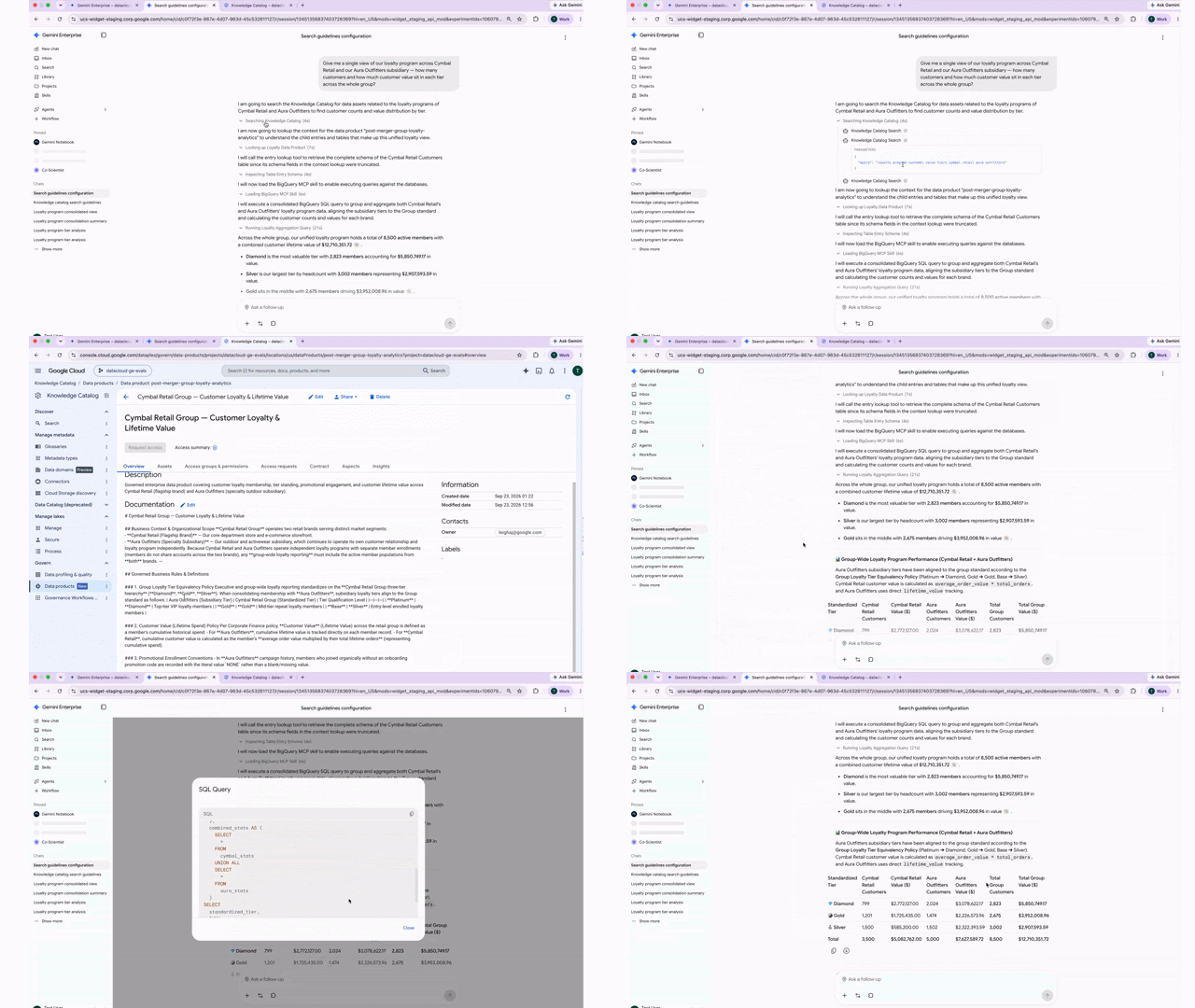
Access data that lives outside of Google Cloud through Gemini The ultimate value of the borderless Lakehouse is realized through the agents you build to transform your organization, with Gemini as the front door. With the new Gemini integration, data that’s either preconfigured or stored in your borderless Lakehouse is now directly integrated into Gemini. Currently in preview, this means you can set up access to new data sources, such as Databricks Unity Catalog or Snowflake Horizon, through Lakehouse catalog federation directly from Gemini.
Now your business users can use natural language to query records that live across clouds while your AI agents can ground their reasoning and generate code from the same data — all without moving it. By directly contextualizing AI agents across your borderless Lakehouse, you can help accelerate your organization’s AI adoption while simplifying access to critical information.
Gemini agents invoked by business users can access data that lives in BigQuery and Databricks Unity Catalog to provide comprehensive reporting and get insights using natural language.
Borderless Lakehouse advancements In addition to this new, native integration with Gemini, we’re sharing that several features we introduced earlier this year to power your data foundation with the borderless Lakehouse are now generally available, including:
Support for Cross-Cloud Interconnect and cross-cloud caching for AWS and Azure
In context
- Topic: Cloud y Arquitectura — Nube pública, híbrida, costos y decisiones de infraestructura.
- Source: Google Cloud Blog
- Published: 15/10/2026
Continue reading at the original source →
Excerpt published automatically by the site radar. The full text belongs to its publisher and is linked above.
Why it matters
The cloud stopped being a technical decision a long time ago. Today it is a financial decision with technical consequences: capital investment gets swapped for monthly spend, and that swap suits some companies very well and others very badly.
What I look at in these announcements is portability. The more comfortable a platform is, the harder it usually is to leave, and that comfort gets paid for in negotiating power three years later, exactly when renewal comes up and there is no credible alternative left.
What usually goes wrong
What I see fail most is the literal migration. The system gets moved exactly as it was, nothing redesigned, and you end up paying hourly for what used to be paid once. It works the same, costs more, and two years later somebody asks why it was done. Lift and shift is not modernising.
What to watch
- Where the data physically sits and what local regulation demands about that.
- What happens when the provider has an outage, because it will, and what keeps running meanwhile.
- Three-year total cost with real growth, not the first-year promotion.
How I read this entry
What I would install alongside any move to the cloud is the discipline of switching things off. Tag everything by owner, review monthly what is running unused, and give somebody the authority to turn it off. Without that, waste eats the promised savings within two years.
This entry is an excerpt from the original source, selected by the site radar. The commentary above is the site's own and does not belong to the cited publisher.
Comments
No comments yet. Yours can be the first.
Living through this in your own team?
Open the chat and tell me how you're handling it. I'm interested in comparing notes.